
The Magic of Visual Routines: Helping Kids Take Ownership of Their Mornings
How a simple chart can turn chaos into confidence

If you’ve ever tried to get kids ready in the morning, you know it can feel like running a small company—with no coffee and very loud employees.
In our house, mornings used to start with constant reminders:
“Brush your teeth.”
“Get dressed.”
“Where are your shoes?”
“Did you pack your lunch?”
By 8 a.m., my voice was tired, my patience was thin, and everyone’s mood was worse.
Then one day, my wife had a simple idea: make it visual.
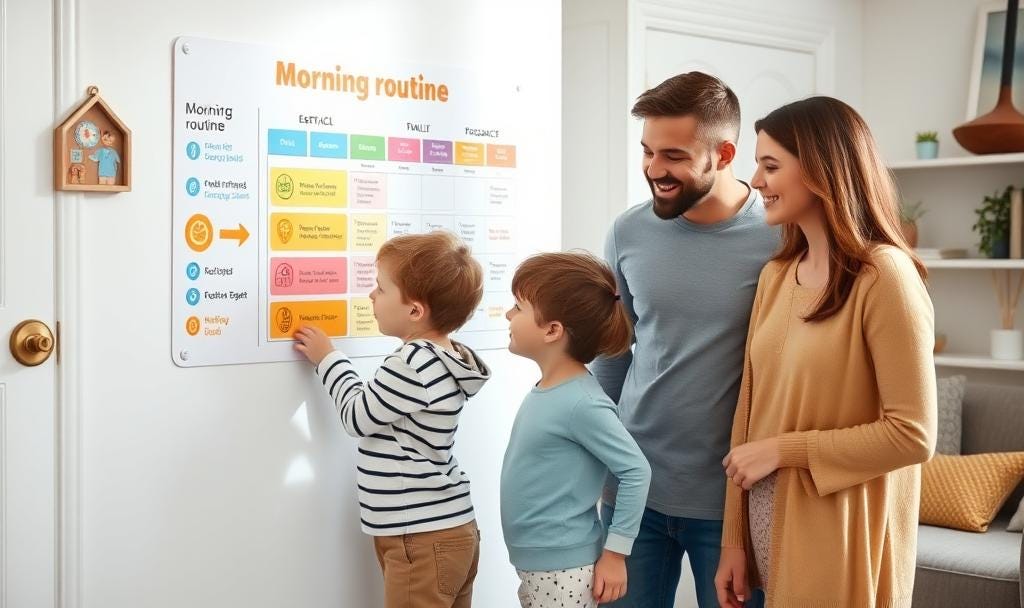
We created a chart with pictures showing each step of the morning—wake up, get dressed, brush teeth, eat breakfast, pack bag. Nothing fancy. Just laminated paper, tape, and a dry-erase marker. But that small shift changed everything.
Why Visuals Work So Well
Kids are visual learners. They process images faster than words. A chart takes abstract expectations (“Get ready for school!”) and makes them concrete.
When our younger kids could see the steps in front of them, the power struggle disappeared. They didn’t need us hovering or nagging—they knew exactly what to do next.
Even our 11-year-old, who’s long past the preschool stage, started using it as a reminder when he got distracted. And honestly? It helped me too. There’s something satisfying about checking off progress, even for adults.
If you’ve never tried it, I’d recommend reading about how to create a morning routine chart for kids. It breaks the process down step by step and shows how to tailor it to your child’s age and personality.
From Nagging to Noticing
The biggest benefit wasn’t the chart itself—it was what it changed in us.
Before, mornings were full of commands. Now they’re filled with encouragement. Instead of “Did you brush your teeth yet?” I can say, “Hey, you’re almost to the last step—nice job.”
That change in tone made a huge difference. Kids respond better when they feel noticed instead of managed. And I’ve realized that how we speak to our kids in those rushed moments matters just as much as the systems we use.
I recently read something that put this into words: staying calm when we communicate teaches kids to stay calm when they respond. It’s one thing to have a routine; it’s another to carry it out with peace instead of pressure. You can see that idea explored more deeply here.
Both structure and tone shape how mornings feel. The chart gives kids direction, and our calm gives them confidence.
How to Make It Work in Real Life
We’ve experimented with a few versions over the years, and here’s what we’ve found helps the most:
Keep it short.
No more than 5–6 steps. Too many and it becomes overwhelming.Use pictures.
Younger kids can’t always read, but they can recognize images instantly.Make it accessible.
Hang it low enough for them to reach. Let them check off each box or move a clip as they finish.Make it collaborative.
Have your kids help design it. Ownership = engagement.Celebrate completion.
When the routine is done, say something positive. “We got ready without any reminders today—that’s awesome.”
These little details keep the chart from being just another thing on the wall and turn it into something your kids actually use.
When Things Don’t Go as Planned
Of course, some mornings still go sideways. Someone spills cereal. Someone forgets homework. Someone moves at the speed of a sleepy sloth.
But the chart helps us focus on the process, not the perfection. Instead of frustration, we can reset together. “Hey, looks like we got off track. Let’s start back at step three.”
And when I remember to keep my tone calm (which is easier said than done), even the rough mornings feel recoverable. Because staying calm communicates safety—and kids listen better when they feel safe.
Bringing It Back to You
If mornings are stressful, try giving your kids the tools to lead themselves. A visual chart might seem simple, but it empowers kids to take ownership—and it saves your voice in the process.
For a step-by-step guide on how to set one up, you can check out this post on building a morning routine chart.
And if you’re looking for more ways to make parenting calmer, smoother, and a little more connected, I’ve gathered practical guides and printables in my bookstore. They’re all designed to help parents turn everyday chaos into peaceful, predictable rhythms.
Because the real goal isn’t just getting out the door—it’s getting there with smiles instead of stress.